
Master the business fundraising process: 5 proven steps
- Janet
- Mar 26
- 10 min read

Securing capital remains one of the most daunting challenges for corporate finance managers and entrepreneurs operating in emerging markets. The fundraising landscape demands more than ambition and a compelling vision. You need a structured approach that anticipates investor expectations, addresses documentation requirements, and navigates complex negotiations with confidence. This comprehensive guide walks you through the entire business fundraising process, from initial preparation through post-investment relationship management, equipping you with actionable frameworks to enhance your capital acquisition strategy and drive sustainable growth.
Table of Contents
Key Takeaways
Point | Details |
Rigorous preparation | Successful fundraising starts long before investor meetings with complete planning and documented materials. |
Investor expectations | Anticipating what investors want increases the odds of securing capital in competitive markets. |
Prepare data room early | Create a well organized digital data room before outreach to speed due diligence and project professionalism. |
Leverage advisory services | Engaging financial and documentation professionals can improve package quality and reduce missteps. |
Preparing your business for fundraising
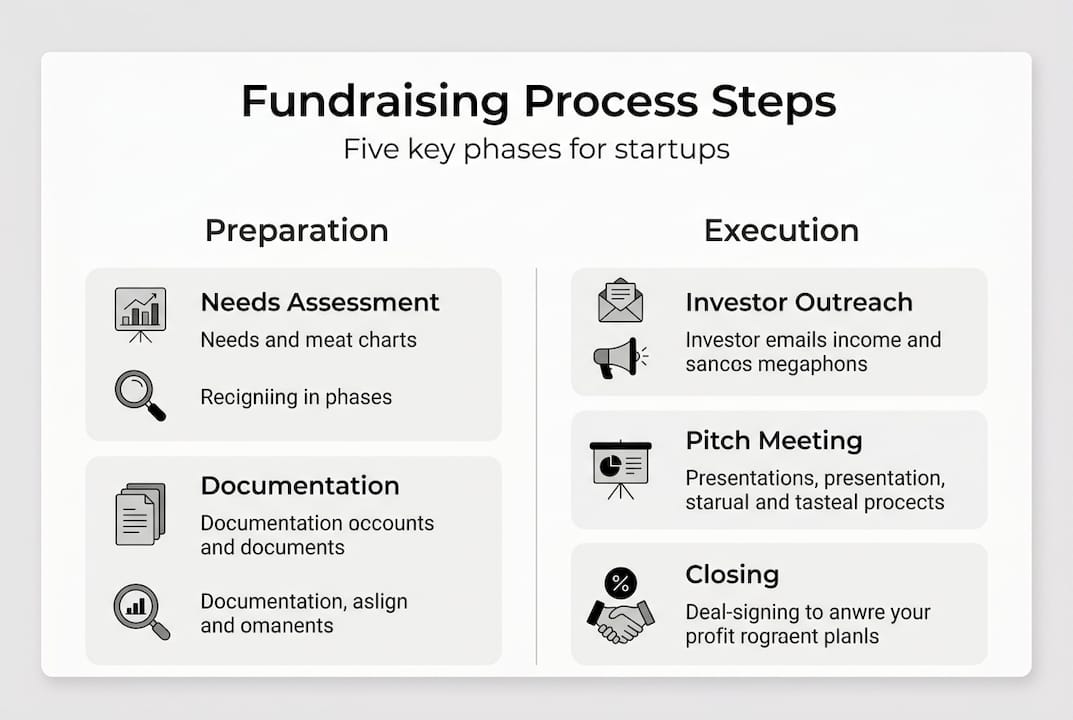
Successful capital acquisition starts long before you approach your first potential investor. The preparation phase determines whether your fundraising campaign will gain traction or stall at the first hurdle. Comprehensive preparation including business planning and documentation is critical for fundraising success, forming the foundation that investors use to assess your venture’s viability and growth potential.
Start by conducting a rigorous assessment of your actual capital needs. Too many entrepreneurs request arbitrary funding amounts without grounding their ask in operational reality. Calculate your runway requirements by projecting monthly burn rates, inventory needs, equipment purchases, hiring timelines, and market expansion costs for at least 18 months. This exercise forces you to think strategically about how capital translates into measurable business milestones.
Your business plan serves as the primary document investors will scrutinize. It must demonstrate deep market understanding, realistic financial projections, and a clear path to profitability. Include detailed sections covering your value proposition, competitive landscape analysis, revenue model, marketing strategy, operational structure, and risk mitigation approaches. Emerging market investors particularly want to see how you’ll navigate regulatory environments, currency fluctuations, and infrastructure challenges specific to your region.
Financial documentation requires meticulous attention. Prepare at minimum three years of historical financial statements if your business is established, or detailed pro forma projections if you’re launching a new venture. Your package should include:
Income statements showing revenue streams and expense categories
Balance sheets demonstrating asset management and liability structure
Cash flow statements proving liquidity and operational efficiency
Financial ratio analysis highlighting profitability, leverage, and growth metrics
Legal documentation often becomes the stumbling block where promising deals collapse. Ensure your corporate structure is properly registered, shareholder agreements are current, intellectual property is protected, and all regulatory compliance requirements are met. Working with experienced business consulting and documentation professionals helps you identify gaps before investors do.
Pro Tip: Create a data room well before starting investor conversations. Organize all documents digitally in clearly labeled folders so you can respond instantly to due diligence requests. Slow document provision signals operational disorganization and kills investor confidence.
Your fundraising pitch deck distills your entire business story into 12 to 15 compelling slides. Focus on the problem you solve, your unique solution, market opportunity size, business model, traction metrics, competitive advantages, team credentials, and specific funding ask with use of proceeds. Emerging market pitches should explicitly address how you overcome local market friction points that might concern international investors.
Document type | Purpose | Typical investor focus areas |
Executive summary | Quick overview for initial screening | Problem, solution, market size, ask |
Business plan | Comprehensive strategy documentation | Revenue model, competitive positioning |
Financial statements | Historical performance proof | Profitability trends, cash management |
Projections | Future growth roadmap | Assumptions, milestone timeline |
Legal documents | Risk and compliance verification | Corporate structure, IP protection |
The quality of your preparation directly correlates with fundraising outcomes. Investors in emerging markets see dozens of pitches monthly. Those backed by professional business planning & analysis stand out immediately through their attention to detail, realistic assumptions, and comprehensive risk acknowledgment.
Executing the fundraising process step by step
With preparation complete, you’re ready to actively pursue capital. A clearly structured fundraising process with phased execution increases investor confidence and fundraising success, transforming what often feels chaotic into a manageable sequence of deliberate actions.

Begin by building a targeted investor list rather than pursuing every possible funding source. Research venture capital firms, private equity groups, angel investor networks, family offices, and development finance institutions that actively invest in your sector and geography. Study their portfolio companies, investment thesis, typical check sizes, and preferred deal structures. This targeting prevents wasting months pitching to investors who will never write a check for businesses like yours.
Your outreach strategy should leverage warm introductions whenever possible. Cold emails to investors rarely succeed. Tap your professional network, advisory board members, industry associations, and existing investors for connections. When warm introductions aren’t available, demonstrate you’ve done homework by referencing specific portfolio companies or recent investments that align with your venture.
The pitch meeting represents your moment to convert interest into commitment. Structure your presentation to tell a compelling story, not recite data points. Open with the market problem, demonstrate why existing solutions fail, introduce your innovation, prove traction through metrics, showcase your team’s execution capability, and close with clear next steps. Anticipate tough questions about competition, unit economics, customer acquisition costs, and exit scenarios.
Pro Tip: Practice your pitch until you can deliver it conversationally without slides. Investors often interrupt with questions, and you need to maintain narrative flow regardless of detours. Record yourself and identify verbal tics, pacing issues, or unclear explanations that undermine your credibility.
Follow this numbered execution sequence for optimal results:
Create your target investor list with 30 to 50 qualified prospects
Secure warm introductions or craft personalized cold outreach for each
Send executive summary and request initial meeting
Deliver pitch presentation and gather feedback
Provide additional documentation for serious prospects entering due diligence
Negotiate term sheets with multiple interested parties simultaneously
Finalize legal agreements with chosen investor
Close transaction and receive funds
Due diligence represents the most intensive phase where investors verify every claim you’ve made. Expect deep dives into financial records, customer contracts, employee agreements, technology infrastructure, and regulatory compliance. Respond promptly and transparently to all requests. Attempting to hide problems always backfires more severely than addressing issues proactively.
Term sheet negotiation requires balancing capital needs against ownership dilution and control provisions. Key terms to scrutinize include valuation, liquidation preferences, board composition, anti-dilution protection, and redemption rights. Emerging market deals often include additional provisions around currency risk, repatriation rights, and governance standards. Engaging experienced investment advisory professionals during negotiations protects you from agreeing to unfavorable terms you’ll regret later.
“The best fundraising outcomes come from entrepreneurs who treat the process like a sales campaign, maintaining momentum, following up persistently, and creating competitive tension among multiple interested investors rather than depending on a single prospect.”
Closing involves finalizing legal documentation, satisfying conditions precedent, and executing fund transfers. Work closely with legal counsel experienced in corporate finance transactions to ensure all agreements protect your interests while meeting investor requirements. Plan for closing to take 30 to 90 days from term sheet signing, depending on deal complexity and due diligence findings.
Common challenges and how to overcome them
Even well-prepared entrepreneurs encounter obstacles during fundraising. Recognizing these challenges early and implementing proven solutions dramatically improves your success probability and reduces time to close.
Investor skepticism represents the most frequent barrier, particularly for emerging market ventures. Investors worry about regulatory instability, currency volatility, limited exit options, and governance standards. Counter skepticism by demonstrating deep local market knowledge, showcasing experienced local team members, providing conservative financial projections that account for market friction, and offering clear exit pathways through strategic acquisitions or regional expansion.
Financial and operational risks can derail promising deals when inadequately addressed. Understanding and mitigating risks enhances fundraising outcomes by showing investors you’ve thought through potential problems and built contingency plans. Common risks include:
Customer concentration where losing one client devastates revenue
Key person dependency without succession planning
Technology vulnerabilities or intellectual property gaps
Supply chain fragility in emerging market contexts
Regulatory changes that could impact business model viability
Documentation pitfalls sink more deals than most entrepreneurs realize. Missing corporate records, unclear cap tables, informal shareholder agreements, unregistered intellectual property, and incomplete financial statements all trigger red flags. Investors interpret documentation problems as indicators of broader operational sloppiness. Invest in professional risk management reviews before starting fundraising to identify and fix issues proactively.
The equity versus debt financing decision confuses many entrepreneurs. Equity investment means selling ownership stakes, diluting your control but bringing strategic partners who share your risk. Debt financing through loan procurement preserves ownership but creates repayment obligations regardless of business performance. Consider this comparison:
Financing type | Ownership impact | Repayment terms | Best for |
Equity | Dilutes ownership percentage | No repayment, investors exit via sale | High growth ventures, early stage |
Debt | Preserves full ownership | Fixed repayment schedule with interest | Established businesses, working capital |
Convertible notes | Temporary debt converting to equity | Converts at next funding round | Bridge financing, seed stage |
Revenue-based | No dilution | Percentage of monthly revenue | Profitable businesses seeking growth |
Valuation disputes frequently stall negotiations. Entrepreneurs overestimate company worth based on emotional attachment, while investors focus on comparable transactions and risk-adjusted returns. Ground your valuation in defensible metrics like revenue multiples, discounted cash flow analysis, or recent transactions for similar companies in your market. Be prepared to justify every assumption.
Timeline management challenges emerge when fundraising drags on for months, consuming management attention and burning through remaining capital. Set clear internal deadlines for each fundraising phase. If you’re not seeing traction after 20 investor meetings, pause to reassess your pitch, valuation, or target investor profile rather than continuing ineffective outreach.
Verifying success and sustaining investor relationships
Closing your funding round marks a beginning, not an ending. How you manage capital deployment and investor relationships directly impacts your ability to raise future rounds and achieve long-term business objectives. Ongoing communication and performance verification build investor trust and facilitate future fundraising by demonstrating you’re a reliable steward of their capital.
Implement rigorous tracking systems for fund utilization from day one. Create a detailed budget allocating invested capital across the specific initiatives outlined in your pitch. Monitor actual spending against projections monthly, investigating any variances exceeding 10%. This discipline prevents the common trap where entrepreneurs spend freely after closing, only to face cash crunches months later without achieving promised milestones.
Establish key performance indicators that align with the growth targets you presented to investors. Track metrics like customer acquisition costs, lifetime value, monthly recurring revenue, gross margins, cash burn rate, and runway remaining. Share these metrics transparently in regular investor updates, celebrating wins while honestly addressing shortfalls and corrective actions.
Investor communication should follow a consistent schedule. Best practice includes:
Monthly email updates covering financial performance, operational highlights, challenges faced, and upcoming priorities
Quarterly board meetings or formal presentations for significant investors
Immediate notification of material changes like key hires, major customer wins or losses, strategic pivots, or unexpected problems
Annual strategy sessions to align on long-term direction
Pro Tip: Over-communicate during your first year post-investment. Frequent updates build confidence and establish you as a trustworthy partner. Investors who feel informed become your strongest advocates, opening doors to customers, talent, and future funding sources.
Transparency about challenges strengthens rather than weakens investor relationships. Every business encounters setbacks. Investors respect entrepreneurs who acknowledge problems early, present thoughtful analysis of root causes, and propose concrete solutions. Hiding bad news until quarterly meetings destroys trust and limits investors’ ability to provide helpful guidance or connections.
Maintaining strong investor relationships positions you advantageously for future fundraising rounds. Satisfied investors provide follow-on funding, introduce you to their networks, and serve as credible references for new prospects. They become partners in your success rather than skeptical overseers scrutinizing every decision.
Prepare for subsequent funding rounds by documenting your progress against initial projections. Create a compelling narrative showing how you’ve deployed capital effectively, achieved key milestones, learned from setbacks, and positioned the business for accelerated growth. This track record makes future fundraising dramatically easier than your initial round.
Leverage professional corporate finance expertise to optimize your post-investment operations. Experienced advisors help you implement financial controls, prepare investor materials, navigate governance requirements, and plan strategic initiatives that maximize your valuation for future rounds. Their guidance proves particularly valuable when managing relationships with multiple investors who may have competing priorities or different risk tolerances.
Consider establishing an advisory board including your lead investors, industry experts, and experienced entrepreneurs. These advisors provide strategic guidance, make valuable introductions, and help you avoid common pitfalls. Regular advisory board meetings create structured opportunities for substantive discussions about business direction beyond routine operational updates.
Your success verification process should include formal milestone reviews every six months. Assess whether you’ve achieved the objectives outlined in your initial pitch, identify factors that accelerated or hindered progress, and adjust your strategy based on market feedback. This disciplined approach to financial advisory and consulting ensures you remain accountable to your vision while staying flexible enough to capitalize on unexpected opportunities.
Explore expert financial and investment advisory services
Navigating the business fundraising process successfully requires more than determination and a solid business plan. You need experienced partners who understand emerging market dynamics, investor expectations, and the intricate details that separate funded ventures from rejected pitches. Maramoja Enterprises specializes in comprehensive investment advisory services designed specifically for businesses operating across Africa and Dubai, providing the strategic guidance and professional positioning that enhances fundraising outcomes.

Our corporate finance experts work alongside you throughout the entire capital acquisition journey, from initial preparation through post-investment relationship management. We help you structure compelling pitches, navigate complex negotiations, implement robust risk management frameworks, and maintain investor confidence through transparent reporting and strategic execution. Contact Maramoja Enterprises today to discover how our tailored financial solutions can accelerate your fundraising success and support your long-term growth objectives.
Frequently asked questions
What documents are essential for a successful business fundraising process?
You need a comprehensive business plan, three years of financial statements or detailed projections, legal documents proving corporate registration and compliance, shareholder agreements, intellectual property documentation, and a compelling pitch deck. Business consulting and documentation professionals can help ensure your package meets investor standards and addresses common due diligence requirements specific to emerging markets.
How can emerging market entrepreneurs identify the best investors for their business?
Research investor portfolios to find firms actively investing in your sector and geography, studying their typical check sizes and preferred deal structures. Analyze their investment thesis and portfolio company profiles to ensure alignment with your business model and growth stage. Engaging investment advisory services provides access to extensive investor networks and helps you target prospects most likely to fund ventures like yours.
What are common fundraising mistakes to avoid?
The most damaging mistakes include incomplete or disorganized documentation, unrealistic valuation expectations, poor investor communication, and pitching to misaligned funding sources. Entrepreneurs also frequently fail by not creating competitive tension among multiple interested investors or by accepting unfavorable terms without proper negotiation. Professional business consulting and documentation support helps you avoid these pitfalls through structured preparation and expert guidance.
How important is ongoing communication with investors after fundraising?
Regular, transparent communication builds essential trust and positions you favorably for future funding rounds. Investors who feel informed become strategic partners, opening doors to customers, talent, and additional capital sources. Consistent updates demonstrating progress against milestones, honest acknowledgment of challenges, and clear strategic direction strengthen relationships and support long-term business success through expert corporate finance management practices.
Recommended
Comments