
Why financial management matters for SME growth: 72% fail
- Janet
- 6 hours ago
- 8 min read

TL;DR:
Most SME failures in emerging markets are caused by poor financial management rather than market conditions.
Implementing core practices like budgeting, cash flow monitoring, and accurate financial recording enhances long-term sustainability.
Building internal financial skills and systems is essential for SME growth, access to funding, and resilience against crises.
Across emerging markets, SME failure rates tell a sobering story. 72% of South African SMEs collapse within three to four years, and 80% of SMEs in the DR-Congo fail within five years. The common thread is not a lack of customers or ambition. It is poor financial management. Many business owners chase external funding without first building the internal systems that make funding work. This article presents evidence-based, practical strategies to help you build financial resilience, manage resources more effectively, and position your SME for sustainable growth in competitive, fast-moving markets.
Table of Contents
Key Takeaways
Point | Details |
SME survival depends on financial management | The ability to budget, control cash flow, and track finances is critical to keeping your business resilient. |
Failure rates are preventable | Most SME collapses result from preventable missteps in money management and financial literacy. |
Growth and innovation require sound finances | Strategic financial management unlocks the resources needed for business expansion and achieving sustainability goals. |
Internal skills matter most | Building your team’s financial knowledge and systems is more powerful than relying on external funding alone. |
The foundations of financial management for SMEs
Financial management, in the SME context, means planning, organizing, and controlling your business’s money so that every dollar serves a clear purpose. It is not just bookkeeping. It is the discipline that connects your daily operations to your long-term goals.
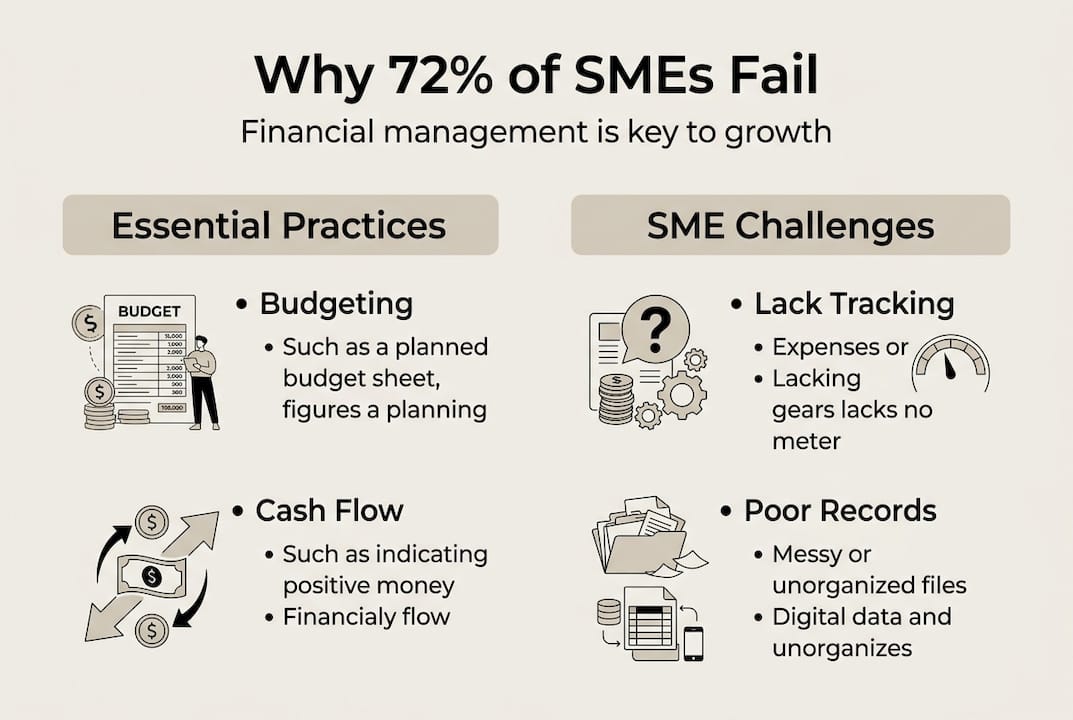
Our financial management guide identifies three core pillars that every SME owner must understand and implement:
Budgeting: A budget is your financial blueprint. It forces you to allocate revenue to costs, salaries, and growth before money is spent. Without it, spending becomes reactive rather than strategic.
Cash flow management: Revenue and profit are not the same as cash in hand. Many profitable SMEs fail because they run out of cash while waiting for invoices to be paid. Monitoring inflows and outflows weekly prevents this.
Financial recording: Accurate records give you a real-time picture of your business’s financial health. They also form the foundation for tax compliance, investor reporting, and loan applications.
Research confirms that budgeting and cash flow management significantly impact SME sustainability. This is not theoretical. Businesses that track their numbers consistently make faster, better decisions. They spot problems early and act before those problems become crises.
Understanding how finance drives business growth starts with getting these fundamentals right. Think of budgeting, cash flow, and recording as the three legs of a stool. Remove one, and the whole structure becomes unstable.
Pro Tip: Set aside 30 minutes every Friday to review your weekly cash flow. This single habit gives you an early warning system that most SME owners lack.
How poor financial health accelerates SME failure
The numbers are stark. SME failure rates in emerging markets reveal that poor financial health is the primary driver of business collapse, not market conditions or competition alone.

Region | Failure rate | Timeframe |
South Africa | 72% | Within 3 to 4 years |
DR-Congo | 80% | Within 5 years |
Sub-Saharan Africa (general) | 60%+ | Within first 5 years |
The causes behind these figures follow a predictable pattern. Poor budgeting leads to overspending in good months and cash shortages in slow ones. Cash mismanagement means businesses cannot meet payroll or supplier obligations, even when sales are strong. Low financial literacy means owners cannot read their own financial statements or identify when their business is heading toward distress.
“Access to finance is not enough. Without the internal skills to manage that finance, SMEs remain vulnerable regardless of how much capital they raise.”
Early warning signs of financial distress include:
Consistently late payments to suppliers
Overdraft usage becoming a regular occurrence
Revenue growing while profits shrink
Inability to forecast next month’s cash position
Increasing reliance on short-term debt to cover operating costs
Proactive monitoring is the solution. Optimizing your financial workflow means building review cycles into your operations, not just reacting to problems after they surface. Similarly, understanding financial risk management helps you identify exposure before it becomes a liability.
The businesses that survive and grow are not necessarily the ones with the most funding. They are the ones that know exactly where their money is, where it is going, and what it needs to do next.
Strategic practices: Budgeting, cash flow, and risk management
Knowing what can go wrong is only useful if you act on it. The good news is that the key methodologies for effective SME financial management are well-established: cash flow management, budgeting, financial recording, liquidity and profitability monitoring, and cost control.
Methodology | What it does | Practical tool |
Cash flow management | Tracks money in and out in real time | Weekly cash flow statements |
Budgeting | Allocates resources before spending occurs | Monthly operating budgets |
Financial recording | Maintains accurate transaction history | Cloud-based accounting software |
Liquidity monitoring | Measures ability to meet short-term obligations | Current ratio tracking |
Cost control | Identifies and reduces unnecessary expenditure | Expense category reviews |
Here is a practical sequence to implement these strategies in your business:
Set a monthly budget before the month begins. Base it on realistic revenue forecasts, not optimistic projections.
Track cash flow weekly. Record every inflow and outflow. Identify gaps before they become crises.
Monitor your liquidity ratio (current assets divided by current liabilities). A ratio above 1.5 signals healthy short-term stability.
Review costs quarterly. Identify which expenses are generating returns and which are draining resources without clear benefit.
Use digital tools to automate recording and reporting. This reduces errors and saves hours each week.
For SMEs in emerging markets, best SME financing practices also highlight cluster financing and cooperative models as effective ways to access capital while sharing financial management resources.
Pro Tip: Before adopting any digital accounting tool, map your current financial processes on paper first. Tools work best when they automate a process that already makes sense, not one that is still disorganized.
Our strategic planning best practices and custom financial solutions can help you build these systems with the right structure from the start.
Financial management as the engine for growth and innovation
Strong financial management does more than keep a business alive. It creates the conditions for growth, innovation, and long-term competitiveness. When your finances are stable and well-monitored, you have what researchers call “financial slack,” meaning surplus capacity to invest in new opportunities without destabilizing your core operations.
Research shows that financial management enables innovation and SDG (Sustainable Development Goals) alignment by providing exactly this kind of slack for strategic investments. For SMEs in emerging markets, this is particularly significant. The ability to fund a product upgrade, enter a new market, or hire a specialist depends on having financial breathing room.
Here is how sound financial management directly enables growth:
Investment readiness: Investors and lenders assess financial records before committing capital. Clean, organized financials signal credibility and reduce the cost of raising funds.
Innovation capacity: Businesses with controlled costs and healthy cash flow can allocate resources to research, development, and product improvements.
Market expansion: Entering new markets requires upfront spending. Businesses with strong liquidity can absorb that cost without threatening daily operations.
SDG alignment: Sustainable business practices, including responsible resource use and community investment, require financial planning. SMEs that integrate sustainability into their financial strategy gain access to impact investors and development finance.
Global competitiveness: SME digitization and resilience studies confirm that digitally enabled SMEs outperform peers in financial visibility, decision speed, and climate resilience.
Statistic to note: SMEs that actively monitor profitability and liquidity are significantly more likely to survive economic shocks and pursue growth opportunities within a three-year window.
Our business planning analysis services help SMEs translate financial discipline into concrete growth strategies. When you understand your numbers, you can make confident decisions about where to invest, when to scale, and how to protect what you have built.
Why most SMEs underestimate financial management and pay the price
After years of working with SMEs across Africa and Dubai, we have observed a consistent pattern. Business owners invest enormous energy in securing external finance but very little in building the internal capabilities to manage it. They treat financial management as an administrative task rather than a strategic one.
This is a costly mistake. Financial literacy and entrepreneurial competencies are what drive SME financial performance, moderated by corporate governance. External capital without internal capability is like fuel without an engine. It does not move you forward.
The businesses we see thrive are those that prioritize skills, systems, and governance alongside their funding efforts. They train their teams to read financial statements. They establish clear approval processes for expenditure. They build governance structures that hold financial decisions accountable.
Our corporate finance advisory work consistently shows that SMEs with strong internal financial systems attract better terms from lenders, close deals faster, and recover from setbacks more quickly. The lesson is simple: before you seek more capital, strengthen your capacity to manage what you already have.
Take your SME’s financial management to the next level
The strategies covered in this article are proven and practical. But implementing them effectively often requires expert guidance, especially when your business is growing quickly or operating in a complex market environment.

At Maramoja Enterprises, we specialize in helping SME owners build the financial systems, strategies, and governance structures that drive real, sustainable growth. Our business consulting and documentation services help you organize your financial foundation. Our financial advisory services provide strategic guidance tailored to your market and goals. And our business planning analysis turns your financial data into a clear roadmap for growth. Reach out to our team and take the next step toward building a financially resilient business.
Frequently asked questions
What are the most common mistakes SMEs make in financial management?
The most common mistakes include poor budgeting, infrequent cash flow monitoring, and neglecting proper financial records. These gaps leave businesses vulnerable to failure even when sales are growing.
How can financial management help my business grow sustainably?
It provides structure for budgeting, cash flow, and investment planning, enabling innovation, stability, and global competitiveness. Strong financial management enables innovation and SDG alignment by creating capacity for strategic investment.
What practical steps can SME owners take to improve financial management quickly?
Start by creating monthly budgets, tracking cash flows every week, and implementing cost control reviews each quarter. These core methodologies are the fastest path to improved financial visibility and control.
Does financial literacy really affect SME success?
Yes. SMEs with strong financial literacy and governance are significantly more likely to achieve long-term sustainability, attract investment, and recover from economic disruptions.
Are digital tools effective for SME financial management in emerging markets?
Digital tools help SMEs streamline records, gain visibility into their finances, and make faster decisions. Digitized SMEs show stronger resilience in the face of climate and economic shocks compared to peers relying on informal systems.
Recommended
Comments