
Why business advisory is essential for strategic growth
- Janet
- 4 days ago
- 8 min read

Most business leaders assume advisory services are reserved for large multinationals with deep pockets and complex org charts. That assumption is costly. Across Africa and Dubai, small and mid-sized enterprises (SMEs) are operating in markets where regulatory complexity, capital access, and cross-border expansion demand the same strategic rigor as any Fortune 500 company. In fact, SMEs drive 63% of non-oil GDP in the UAE, yet many still operate without structured advisory support. This article breaks down what business advisory actually does, how it enables growth and funding access, what risks it mitigates, and where it falls short so you can make a fully informed decision.
Table of Contents
Unlocking growth: How business advisory enables expansion and funding
Risk management and regulatory compliance: Avoiding costly pitfalls
Maximizing ROI and sustainability with digital and ESG-focused advisory
Limits and controversies: What to watch out for with business advisory
The real power (and limit) of business advisory: An insider’s take
Key Takeaways
Point | Details |
Advisory drives growth | Business advisory helps companies in Africa and Dubai unlock funding, identify opportunities, and expand sustainably. |
Expertise navigates regulations | Advisors ensure compliance and risk reduction in complex regulatory markets. |
ROI with tech strategies | Digital and ESG-focused advisory offers rapid, substantial returns for businesses that implement their guidance. |
Vet advisors carefully | Choosing the right advisor is crucial; over-reliance can reduce internal capabilities or expose you to compliance risks. |
What is business advisory and who needs it?
Business advisory is a structured service where external experts work alongside your leadership team to improve strategic decisions, financial performance, and operational efficiency. It is not consulting in the narrow sense. It covers a wide range of functions including strategic planning, financial modeling, regulatory compliance, market entry analysis, and growth consulting.
The businesses that benefit most from advisory are not always the largest. In fact, external business advisory for SMEs is often most impactful precisely because smaller firms lack the internal depth to cover all these functions. A startup expanding from Nairobi into Dubai, a mid-sized manufacturer in Lagos seeking trade finance, or a family business in Accra preparing for a merger all face challenges that require specialized, external expertise.
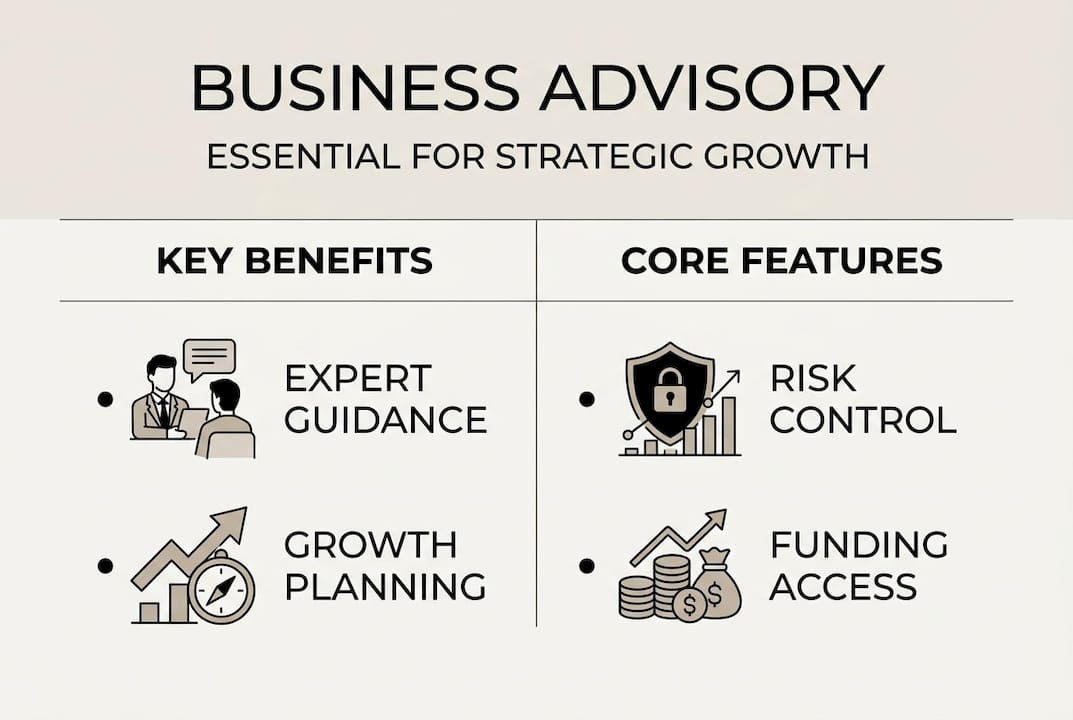
Here is what business advisory typically covers:
Strategic planning: Defining growth roadmaps and competitive positioning
Financial modeling: Building projections, stress-testing scenarios, and structuring capital
Compliance guidance: Navigating tax, legal, and regulatory requirements across jurisdictions
Funding access: Identifying and preparing for debt, equity, or alternative financing
Operational improvement: Streamlining processes to reduce cost and increase margin
For African and Dubai business owners, advisory provides external expertise that most SMEs simply cannot build in-house at an affordable cost. The value is not just in the advice itself. It is in having a credible, experienced partner who has navigated similar markets before.
Pro Tip: Before engaging an advisor, define three specific outcomes you want within 12 months. Vague mandates produce vague results. Clarity on your goals ensures the advisory relationship stays focused and measurable.
Unlocking growth: How business advisory enables expansion and funding
Growth in Africa and Dubai is not linear. Markets shift fast, regulations change, and capital sources are fragmented. SMEs and mid-sized firms often hit a ceiling not because of poor products or services, but because they lack the strategic infrastructure to scale.
Business advisory directly addresses this gap. Strategic financial advisory identifies growth opportunities, optimizes operations, and supports funding access for sustainable development in competitive markets like Dubai. Advisors bring market intelligence, financial structuring skills, and relationship networks that most internal teams cannot replicate.

The UAE’s investment activity in Africa illustrates the scale of opportunity available. The UAE invested $110B in African projects between 2019 and 2023, spanning renewables, infrastructure, and trade. Advisory firms play a direct role in facilitating market entry and partnerships for African businesses looking to attract or participate in these flows.
Here is how a structured advisory engagement typically supports expansion:
Market assessment: Advisors analyze target markets, competitive dynamics, and regulatory requirements before you commit capital.
Financial structuring: They design the right mix of debt, equity, and instruments like letters of credit or bank guarantees to fund expansion.
Compliance preparation: They ensure your business meets local requirements so you are not blocked at the entry point.
Partnership facilitation: Advisors leverage networks to connect you with the right investors, distributors, or joint venture partners.
Ongoing monitoring: They track performance against milestones and adjust strategy as conditions evolve.
“The difference between businesses that scale successfully and those that stall is rarely the idea. It is the quality of the strategic and financial infrastructure behind the execution.”
Understanding trade finance and capital flows between Africa and Dubai is one area where advisory adds immediate, tangible value. Knowing which instruments to use, which banks to approach, and how to structure documentation can mean the difference between securing funding and losing the deal. See how finance drives business growth in emerging markets for a deeper look at capital strategy.
Risk management and regulatory compliance: Avoiding costly pitfalls
Growth without risk management is a liability. Across Africa and Dubai, businesses face layered compliance obligations: corporate tax regimes, anti-money laundering (AML) requirements, cross-border trade regulations, and sector-specific licensing. Missing any one of these can result in penalties, operational shutdowns, or reputational damage.
SMEs driving 63% of non-oil GDP in the UAE face particularly complex regulatory environments, where compliance is not optional. Business advisors help you anticipate these requirements before they become problems.
The most common compliance challenges for African and Dubai businesses include:
Multi-jurisdictional tax obligations when operating across borders
AML and KYC (Know Your Customer) requirements for financial transactions
Sector licensing in regulated industries like finance, healthcare, and energy
Employment law compliance across different labor markets
Foreign ownership restrictions that vary by country and free zone
Advisors do more than flag risks. They build frameworks. A good advisory team helps you create internal compliance checklists, assign accountability, and establish review cycles so that compliance becomes a managed process rather than a reactive scramble. For a structured approach to financial management in Dubai, these frameworks are foundational.
Pro Tip: Build a compliance calendar at the start of each fiscal year. Map every regulatory deadline, reporting requirement, and license renewal across all jurisdictions where you operate. Your advisory team can help populate and maintain it.
For businesses that want to go deeper on risk management strategies, the investment in structured advisory pays back quickly when you consider the cost of non-compliance versus the cost of prevention.
Maximizing ROI and sustainability with digital and ESG-focused advisory
The return on investment from business advisory is measurable, and the data is compelling. Technology consulting delivers over 100% ROI in 87.9% of cases studied, with 70% of engagements achieving payback in under six months. These benchmarks apply directly to advisory-driven technology strategies, where advisors guide digital transformation decisions.
For businesses in Africa and Dubai, digital adoption is no longer optional. Advisory firms help you select the right platforms, structure implementation plans, and measure outcomes. The MEA consulting market benchmarks show UAE SMEs achieving 200 to 600% ROI on ERP and automation projects when guided by experienced consultants.
Beyond digital, ESG (Environmental, Social, and Governance) alignment is becoming a prerequisite for accessing institutional capital. Investors and development finance institutions increasingly require ESG reporting and sustainability frameworks before committing funds. Advisory firms help you build these frameworks in ways that are credible, auditable, and aligned with international standards.
Key areas where digital and ESG advisory drives ROI:
ERP and automation implementation guided by advisors with sector-specific experience
ESG reporting frameworks that satisfy investor due diligence requirements
Green finance structuring for renewable energy and sustainability-linked projects
Data analytics integration to improve decision-making speed and accuracy
Carbon accounting for businesses operating in regulated or investor-scrutinized sectors
When evaluating an advisory partner for corporate finance strategies, ask for documented case studies with measurable ROI. Any credible firm should be able to show you specific outcomes from comparable engagements. For businesses focused on investment advisory for ESG, alignment between your sustainability goals and the advisor’s track record is non-negotiable.
Limits and controversies: What to watch out for with business advisory
Business advisory is not without its critics, and the concerns are legitimate. The most significant risk is not bad advice. It is dependency. When businesses outsource strategic thinking entirely to external advisors, they stop building internal capability. Over time, this creates a structural weakness where the organization cannot function without external support.
Critics note risks in geopolitical tensions, illicit trade facilitation, and over-reliance on advisory without building internal capability. These are real concerns, particularly for African businesses engaging advisors connected to foreign investment networks where interests may not always align.
Here is what to watch for when vetting an advisory firm:
Conflicts of interest: Does the advisor earn commissions from financial products they recommend?
Capability transfer: Is the engagement designed to build your team’s skills, or just deliver outputs?
Track record verification: Can they provide references from clients in comparable markets?
Contractual clarity: Are deliverables, timelines, and success metrics clearly defined?
Geopolitical exposure: For cross-border advisory, understand whose interests the advisor ultimately serves.
“The best advisory relationships are structured so that the client becomes less dependent on the advisor over time, not more.”
Reviewing business growth case studies from firms with demonstrated regional experience is one of the most reliable ways to assess whether an advisor delivers genuine, transferable value or simply generates reports.
The real power (and limit) of business advisory: An insider’s take
After nearly two decades of working with businesses across Africa and Dubai, we have seen one pattern repeat itself. The companies that extract the most value from advisory are not the ones with the biggest budgets. They are the ones that treat advisory as a co-creation process rather than an outsourced function.
Most value is lost when leadership hands over a problem and waits for a solution. The real return comes when your team works alongside advisors, absorbs the methodology, and builds internal capacity in parallel. Advisory is a catalyst, not a substitute for leadership.
We have also seen the contrarian case. Some businesses that declined advisory support were forced to solve problems internally, and in doing so, built capabilities that became genuine competitive advantages. The lesson is not that advisory is always necessary. It is that the decision to engage should be deliberate, not reflexive.
What matters most is the quality of the partnership. A good advisor challenges your assumptions, brings evidence-based perspectives, and holds you accountable to outcomes. For practical frameworks on real-world financial management in emerging markets, the principles are consistent: clarity of purpose, disciplined execution, and honest performance review.
Take your business further with expert advisory solutions
The insights in this article point to one clear conclusion: structured advisory support is a strategic asset for businesses serious about growth, compliance, and sustainable performance in Africa and Dubai.

At Maramoja Enterprises, we have been partnering with business owners and corporate decision-makers since 2005 to deliver exactly this. Our business consulting and documentation services cover everything from strategic planning to financial documentation. Our comprehensive financial advisory practice supports capital structuring, fundraising, and market entry. For businesses seeking debt financing, our loan procurement services connect you to the right facilities. Contact us to schedule a consultation and take the next step.
Frequently asked questions
What are the main benefits of business advisory for SMEs in Dubai or Africa?
Business advisory simplifies complex regulations, enables access to funding, and supports strategic growth tailored to fast-evolving markets. SMEs driving 63% of non-oil GDP in the UAE rely on advisory to stay compliant and competitive.
How does business advisory help with fundraising and market entry?
Advisors connect businesses to the right funding sources, provide market intelligence, and facilitate partnerships to enable successful market entry. With the UAE investing $110B in Africa between 2019 and 2023, advisory firms are central to helping African businesses access these capital flows.
Can business advisory guarantee high ROI?
When aligned with digital and ESG strategies, advisory often delivers rapid ROI, but outcomes depend on selecting the right partner and implementing advice consistently. Over 87.9% of technology consulting cases show returns exceeding 100%, which reflects what disciplined advisory execution can achieve.
What are the major risks of relying on business advisory?
Risks include over-dependence, limited internal expertise development, and exposure to geopolitical or compliance lapses if advisors are not well-vetted. Critics highlight risks around illicit trade facilitation and capability gaps when businesses fail to build internal knowledge alongside external advisory support.
Recommended
Comments