
Optimize financial management workflow for peak efficiency
- Janet
- 12 minutes ago
- 8 min read

TL;DR:
Effective financial workflows improve performance, reduce costs, and enable faster month-end closes.
Automation, real-time data, and scenario planning are key to top-quartile finance performance.
Overcoming resistance and scaling processes are crucial for successful workflow transformation.
Finance teams across Africa and Dubai lose weeks to month-end closes and spreadsheet errors that compound into real strategic costs. Top-quartile firms close the books in 5 days and cut finance costs to just 0.55% of revenue. The gap between those firms and the rest is not talent. It is workflow design. This guide walks you through every stage of building a modern, efficient financial management workflow, with benchmarks and examples drawn directly from the Africa and Dubai markets where volatility, multi-currency complexity, and rapid growth demand more than generic best practices.
Table of Contents
Key Takeaways
Point | Details |
Structure matters most | An efficient workflow requires clear steps, modern tools, and integrated processes. |
Automation is essential | Automating data flows and approvals cuts errors and closes books faster. |
Benchmark for success | Use metrics like finance cost and close speed to gauge and drive continual improvement. |
Tailor for your region | Africa and Dubai need adaptive workflows to tackle volatility, regulatory changes, and multi-entity realities. |
Understand the essentials: What is an efficient financial management workflow?
With workflow inefficiencies in mind, let us clarify what a robust financial management process should look like.
A financial management workflow is the structured sequence of activities your finance function uses to plan, execute, monitor, and report on financial performance. For organizations operating across Africa and Dubai, this is not a back-office formality. It is a strategic engine. Our corporate finance overview outlines how well-designed workflows connect capital decisions to operational outcomes.
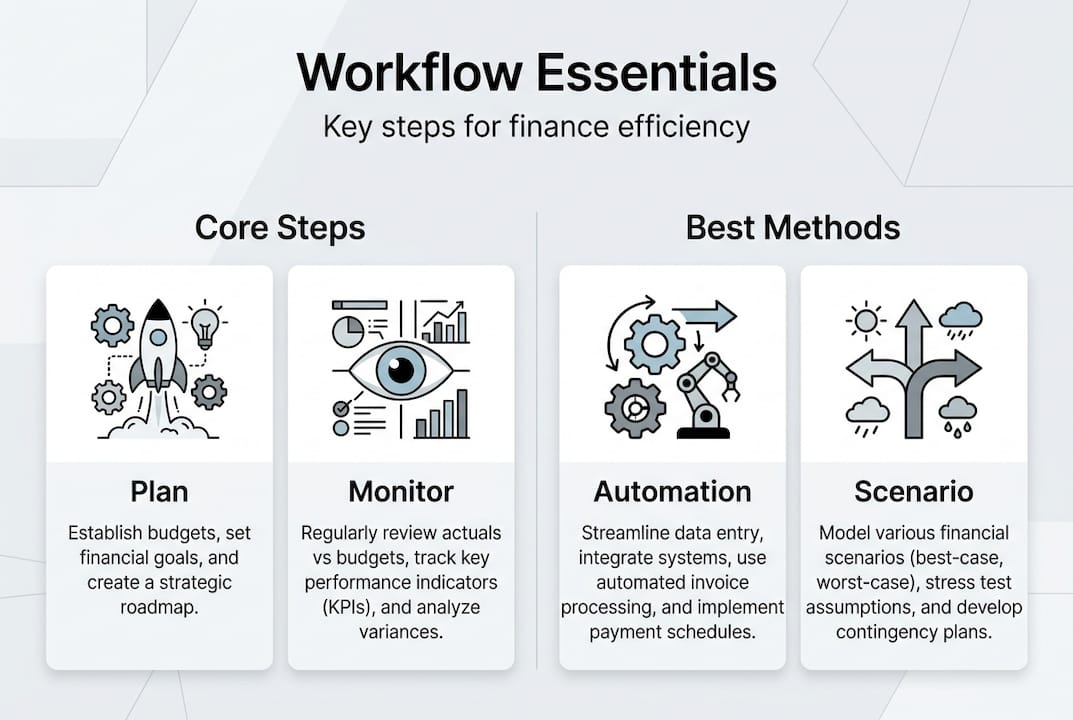
Corporate financial management workflows include six core steps: goal alignment, data gathering, budgeting, forecasting, variance analysis, and continuous monitoring. Each step feeds the next. Skipping or weakening any one of them creates downstream errors that are expensive to fix.
Here is what each step involves:
Goal alignment: Connect financial targets to broader business strategy and regional market conditions.
Data gathering: Consolidate data from ERP systems, bank feeds, and operational reports into a single source of truth.
Budgeting: Translate strategic goals into detailed financial plans by department and cost center.
Forecasting: Project future performance using historical trends, driver-based models, and market assumptions.
Variance analysis: Compare actual results to budget and forecast, then identify root causes of deviation.
Monitoring: Track KPIs continuously and trigger corrective actions before small gaps become large problems.
Key methodologies that separate high performers include driver-based modeling, scenario planning, rolling forecasts, and integrated planning across finance and operations. These approaches replace static, annual thinking with dynamic, real-time decision support.
For context, here are the benchmarks that define workflow performance tiers:
Metric | Top quartile | Median | Laggard |
Finance cost as % of revenue | 0.55% | 1.0% | 2.0%+ |
Month-end close time | 5 days | 8 days | 15+ days |
Process automation rate | 80%+ | 50% | Under 30% |
Forecast accuracy | 95%+ | 85% | Below 75% |
If your team sits in the median or laggard column, the gap to top-quartile performance is achievable. Our emerging markets finance guide and financial advisory and consulting services are built around exactly this kind of structured improvement.
Set up your workflow: Tools, technology, and prerequisites
Now that you know what an effective workflow entails, here is how to get your organization set up for success.
Before you touch a single tool or template, you need three foundational prerequisites in place. Without them, even the best technology investment will underdeliver.
Leadership buy-in: Finance transformation stalls without executive sponsorship. Your CFO and business unit heads must align on workflow goals and resource commitments before rollout begins.
Data streamlining: Audit your current data sources. Identify duplicates, manual entry points, and reconciliation bottlenecks. Clean data is the foundation of every reliable forecast.
Clear roles and responsibilities: Assign ownership for each workflow step. Ambiguity about who approves, who inputs, and who monitors creates delays and accountability gaps.
Once your prerequisites are in place, your technology choices will have a much higher return. Modern finance functions emphasize automation, AI, and real-time integration, shifting away from spreadsheets toward ERP and treasury management systems (TMS) that support straight-through processing.
Here is a direct comparison of your two primary options:
Capability | Spreadsheets | ERP/TMS with automation |
Data consolidation | Manual, error-prone | Automated, real-time |
Scenario modeling | Limited | Multi-variable, dynamic |
Audit trail | Weak | Full and auditable |
Scalability | Poor | High |
Integration with BI | Manual export | Native API connection |
Implementation cost | Low upfront | Higher, lower long-term |
For most mid-to-large organizations in Africa and Dubai, the ERP/TMS path delivers far greater long-term value. Key integrations to prioritize include treasury management systems for cash visibility, BI dashboards for real-time KPI monitoring, and scenario modeling tools for stress-testing assumptions.
You can explore how our business planning tools and risk governance essentials support this infrastructure build.
Pro Tip: Automate your data validation rules at the point of entry, not after the fact. Catching errors before they enter the system reduces close time and eliminates the costly rework that keeps finance teams working late into month-end.
Execute the workflow: Step-by-step process for modern finance teams
Preparation is essential, but execution determines results. Here are exact steps refined for your region.
Align goals with strategy: Begin each planning cycle by confirming that financial targets reflect current business priorities, including regional expansion, FX assumptions, and regulatory changes specific to your operating markets.
Gather and validate data: Pull data from ERP, banking portals, and operational systems. Run automated validation checks before any analysis begins.
Build your budget and forecast: Use driver-based models that link revenue assumptions to cost structures. Replace static annual budgets with rolling forecasts that update monthly or quarterly.
Run variance analysis: Compare actuals to plan. Quantify the gap, identify the driver, and escalate material variances to decision-makers within 48 hours of period close.
Execute scenario planning: Model at least three scenarios: base, upside, and downside. In markets with FX volatility, include currency stress tests as a standard step.
Monitor and adjust continuously: Use real-time dashboards to track KPIs. Set automated alerts for threshold breaches so your team responds proactively, not reactively.
Top-performing finance functions use structured scenario planning, rolling forecasts, and real-time data to improve outcomes and strategic alignment. This is not aspirational. It is the operating standard for firms that consistently outperform their peers.
A strong regional example comes from the UAE. Treasury centralization at Al-Futtaim used in-house banking, cash pooling, integrated dashboards, and FX mitigation to boost liquidity and reduce risk across a complex, multi-entity structure. Our guide on Dubai treasury best practices covers how similar frameworks apply to Africa-facing operations.
“In volatile markets, the finance team that updates its forecast monthly will always outmaneuver the team that waits for the annual budget cycle to catch up.”
Pro Tip: Connect your scenario planning tool directly to your BI dashboard. When assumptions change, your KPIs should update instantly so leadership can make decisions in the same meeting, not the next one.
Avoid pitfalls: Common challenges and how to verify success
Even strong execution can stumble. Here is how to avoid common traps and ensure continuous improvement.
The most damaging workflow failures are rarely dramatic. They are slow, quiet erosions caused by habits that once worked but no longer scale. Watch for these specific problems:
Spreadsheet reliance: Manual models introduce errors, slow down closes, and create version control chaos across teams.
Lack of automation: Finance teams that manually reconcile data spend time on tasks that add no strategic value.
Rigid budgeting: Annual budgets that do not flex with market conditions leave organizations exposed to avoidable variance.
M&A disruptions: Acquisitions that do not integrate financial systems quickly create reporting blind spots and governance gaps.
Multi-jurisdiction VAT and compliance issues: Operating across African markets and Dubai requires workflows that accommodate different tax regimes without manual workarounds.
Manual spreadsheet reliance leads to errors, delays, and cost overruns. Structured automation reduces budgeting time by 11% and strategic misalignments by 14%. Those are not marginal gains. They compound across every planning cycle.

It is also worth noting that public sector budgets focus on compliance over growth, while private sector organizations demand more agility. If your workflow was designed for a compliance-first environment, it may be actively limiting your strategic responsiveness.
To verify your workflow is performing, track these KPIs consistently:
Finance cost as a percentage of revenue (target: below 1%)
Month-end close time (target: 5 to 7 days)
Percentage of processes automated (target: 70% or higher)
Forecast accuracy rate (target: 90% or higher)
Strategic alignment improvement score (measured quarterly)
For more detail on protecting your workflow from risk, our risk management tips and risk management strategies pages offer frameworks built for the markets you operate in.
The uncomfortable truth about financial management workflow transformation
Most workflow transformation programs fail not because of technology gaps, but because of political resistance that nobody names out loud. Business unit leaders protect their autonomy. Regional teams resist centralization because it feels like a loss of control, even when the cost savings are clear. We have seen this pattern repeatedly across Africa and Dubai.
The second failure mode is dependence on hero employees. When your financial close depends on one person who knows where every formula lives, you do not have a workflow. You have a risk. Processes must scale beyond individuals.
What actually works is a hybrid approach: centralize governance and reporting standards while preserving local flexibility for market-specific inputs. Pair that with an automation-first mindset and benchmark your performance against global peers, not just regional norms. Finance growth in emerging markets requires this kind of disciplined thinking to translate into sustainable competitive advantage.
How Maramoja Enterprises can accelerate your financial management transformation
If you are ready to transform your finance workflow, our team can support your next steps.
At Maramoja Enterprises, we have spent nearly two decades helping organizations across Africa and Dubai redesign their financial management workflows for real-world performance. We bring end-to-end advisory across workflow design, automation strategy, and regional compliance, so your finance function operates at the standard the best firms have already reached.

Whether you need structured business consulting services, specialized financial advisory solutions, or targeted corporate finance support for capital structuring and strategic planning, we build solutions around your specific operating context. Contact us to discuss how we can help your team close faster, forecast better, and align finance with growth.
Frequently asked questions
What is the difference between static budgets and rolling forecasts?
Static budgets fix targets annually and become outdated quickly in dynamic markets, while rolling forecasts update continuously to reflect current conditions, giving finance teams far greater agility for real-time decision-making.
Which KPIs define a high-performing finance workflow?
Key KPIs include finance cost as a percentage of revenue, month-end close time, and process automation rate. Top-quartile benchmarks sit at 0.55% finance cost, a 5-day close, and 80% or higher automation.
How does treasury centralization help corporations in Dubai?
Treasury centralization improves liquidity and reduces fees by integrating cash management through in-house banking, cash pooling, and BI dashboards, while also providing structured tools to mitigate FX risk across multi-currency operations.
Why is process automation critical in financial management workflows?
Automation and AI underpin agile, efficient finance workflows by minimizing manual errors, accelerating period closes, and freeing your finance team to focus on strategic analysis rather than data reconciliation.
Recommended
Comments