
Financial management guide for emerging markets and Dubai
- Janet
- 6 days ago
- 7 min read

A profitable business can still fail. That statement surprises many business owners, yet it reflects a documented reality in emerging markets and Dubai alike. Poor cash flow can bring down a firm that looks healthy on paper, making financial management far more than a back-office function. This guide covers the core pillars of financial management, from planning and budgeting to capital structuring and sustainable growth, giving you a practical framework to protect and grow your business with confidence.
Table of Contents
Key Takeaways
Point | Details |
Financial management essentials | Effective planning, budgeting, and monitoring drive business success and accountability. |
Optimal capital structuring | Balancing debt and equity using WACC and local tax rules maximizes growth while minimizing risk. |
Profitability fuels sustainable growth | Empirical evidence shows that profitability, not liquidity or size, best predicts sustainable growth rate in emerging markets. |
Cash flow forecasting is critical | Regular forecasting prevents failures—even for profitable firms—and should be a routine management practice. |
Environmental sustainability boosts performance | Integrating green and digital strategies mediates firm performance for lasting impact and competitive edge. |
What is financial management and why is it crucial?
Financial management is the discipline that keeps a business running with purpose and precision. At its core, financial management involves planning, organizing, controlling, and monitoring financial resources to achieve business goals. It is not simply about tracking income and expenses. It is about making deliberate decisions that align your resources with your strategic objectives.
For businesses operating in emerging markets and Dubai, this discipline carries additional weight. The World Bank emphasizes financial management for accountability and efficiency in emerging markets, including public financial management assessments such as PEFA (Public Expenditure and Financial Accountability). These frameworks signal to investors and partners that your organization operates with rigor and transparency.
Understanding corporate finance basics is the starting point for any business owner who wants to move beyond reactive decision-making. The key areas financial management covers include:
Investment decisions: Allocating capital to assets and projects that generate returns
Procurement and funding: Securing the right mix of financing at the right cost
Risk management: Identifying and mitigating financial exposures before they become crises
Performance monitoring: Tracking financial results against targets and adjusting course
“Effective financial management is not a luxury for large corporations. It is the operational backbone that determines whether a business survives its growth phase or collapses under it.”
Working with financial advisory and consulting professionals helps you build these systems correctly from the start. The role of bookkeepers in maintaining accurate records also forms a critical foundation for every financial decision you make. Sound risk management approaches complete the picture by ensuring your business is protected as it scales.
Core components: Planning, budgeting, and cash flow management
Once you understand what financial management includes, it is critical to see how these elements translate to everyday business actions. Core components for entrepreneurs include financial planning, budgeting, cash flow forecasting, and the strict separation of business and personal funds. Each of these components builds on the others.
Here is a practical breakdown of the four essential steps:
Set clear financial goals. Define specific targets such as a 40% gross profit margin or a 6-month operating reserve. Vague goals produce vague results.
Choose the right budgeting method. Zero-based budgeting requires you to justify every expense from scratch each period. Incremental budgeting adjusts prior figures. Zero-based is more rigorous and better suited for businesses in volatile markets.
Build a cash flow forecast. Project your inflows and outflows monthly or quarterly. This single practice prevents the most common cause of business failure in growing firms.
Separate business and personal finances. Mixing funds creates accounting errors, tax complications, and a distorted view of business performance.
Pro Tip: If your business operates across multiple currencies, as many Dubai and African firms do, build your cash flow forecast in each currency separately before consolidating. Exchange rate shifts can turn a projected surplus into a deficit overnight.
The table below compares the two most common budgeting types used by growing businesses:
Budgeting method | Best for | Key advantage | Key risk |
Zero-based budgeting | High-growth or restructuring firms | Forces cost discipline | Time-intensive to prepare |
Incremental budgeting | Stable, predictable businesses | Fast and familiar | Can entrench inefficiencies |
Rolling forecast | Dynamic, fast-changing markets | Always current | Requires frequent updates |
Strong business planning and analysis ties these components together into a coherent strategy. For firms active in trade finance in Dubai, cash flow forecasting is especially critical given the timing gaps between shipment, documentation, and payment. Exploring loan procurement strategies can also provide the liquidity buffer your business needs during high-demand periods.
Capital structuring: Optimizing debt and equity for growth
With planning and cash flow clear, the next priority is how your company finances its assets and operations. Capital structure is the mix of debt and equity used to fund a business, and getting this mix right directly affects your cost of capital and long-term stability.
The key metric here is WACC, or Weighted Average Cost of Capital. WACC represents the blended cost of all your financing sources. A lower WACC means cheaper capital and higher firm value. Capital structure optimization involves minimizing WACC using the Trade-Off Theory, which balances the tax shield from debt against the risk of financial distress.
In the UAE, the 9% corporate tax introduced in 2023 makes debt financing more attractive because interest payments are tax-deductible. However, interest deductibility is capped at 30% of EBITDA, so over-leveraging carries real risk. This is a meaningful shift for Dubai-based businesses that previously operated in a zero-tax environment.
“The optimal capital structure is not a fixed formula. It shifts with your industry, growth stage, tax environment, and access to capital markets.”
Two major theories guide capital structure decisions:
Theory | Core principle | Practical implication |
Trade-Off Theory | Balance tax benefits of debt against distress costs | Use moderate debt; avoid over-leverage |
Pecking Order Theory | Firms prefer internal funds, then debt, then equity | Retain earnings first; equity is a last resort |
Empirical data from emerging markets suggests that profitability is a stronger predictor of sustainable growth than liquidity, which supports a disciplined approach to retaining earnings before seeking external capital. Reviewing capital deployment models can sharpen your understanding of how capital allocation decisions affect returns.
Pro Tip: Before approaching lenders or investors, model your WACC under three scenarios: conservative, base, and aggressive debt levels. This exercise reveals your true financing ceiling and strengthens your negotiating position.
Exploring your capital structure options with an experienced advisor ensures you are not leaving value on the table. Staying current on Dubai corporate tax changes is equally important as the regulatory environment continues to evolve. Our financing strategies insights provide ongoing guidance for businesses at every stage.
Driving sustainable growth: Financial and environmental strategy
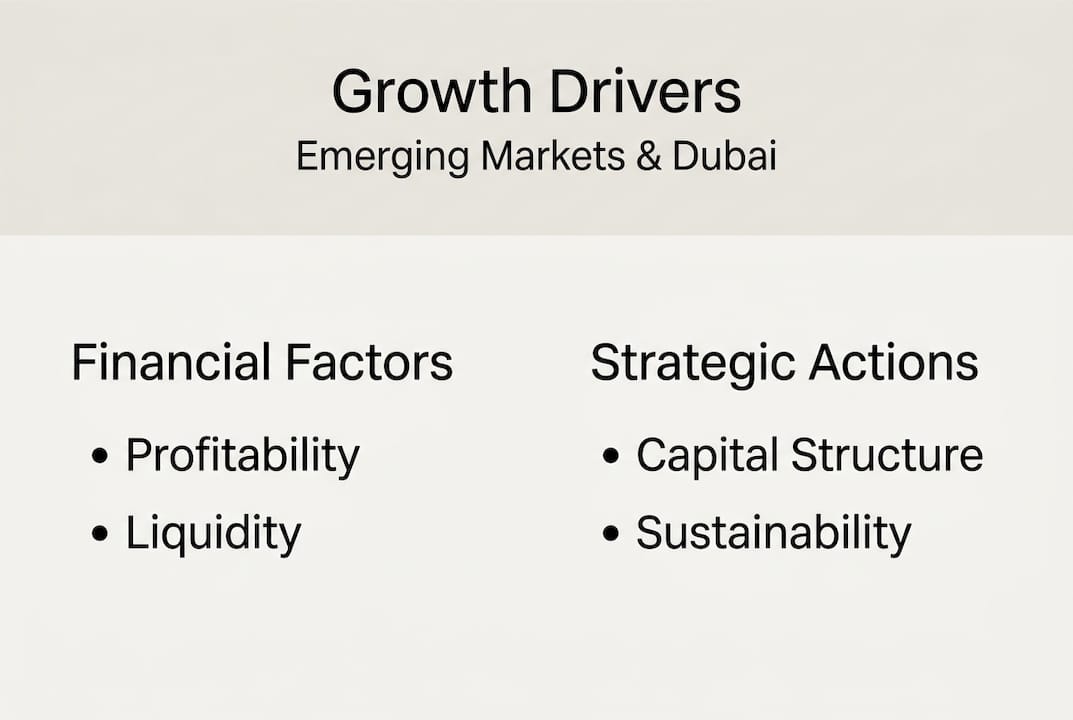
Capital structuring sets the foundation, but sustainable growth requires a broader framework that connects financial performance with long-term strategic positioning. The Sustainable Growth Rate, or SGR, is the maximum rate at which a business can grow without altering its financial structure or requiring new external equity.

A major study on firms listed on the Indonesia Stock Exchange (IDX) covering 2,365 observations from 2019 to 2023 found that profitability positively affects SGR at a statistically significant level (p less than 0.001). Liquidity and firm size showed no significant effect. This finding has direct implications for how you prioritize your financial strategy: focus on margin improvement before chasing volume growth.
The table below outlines the key drivers of sustainable growth and their relative impact:
Growth driver | Impact on SGR | Strategic action |
Profitability (ROE, net margin) | Strong positive | Improve pricing, reduce costs |
Liquidity (current ratio) | Insignificant | Maintain adequate levels only |
Firm size (total assets) | Insignificant | Scale strategically, not for size |
Environmental sustainability | Positive mediator | Integrate ESG into operations |
Beyond financial metrics, environmental sustainability is emerging as a genuine performance driver. Research on Ethiopian manufacturing firms shows that sustainability orientation and proactive digital strategies improve environmental outcomes, which in turn mediate overall firm performance. This is not a compliance exercise. It is a competitive advantage.
For businesses in emerging markets, fiscal policy context also matters. The IMF advises countercyclical fiscal policy for emerging market and middle-income economies, a shift from the procyclical patterns seen before the global financial crisis. Understanding this macro environment helps you time capital raises and expansion decisions more effectively.
Key actions to drive sustainable growth in your business:
Prioritize profitability improvements over aggressive revenue expansion
Integrate environmental and digital strategies as performance levers, not afterthoughts
Monitor fiscal policy signals in your operating markets to time financing decisions
Use SGR as a planning benchmark to avoid over-extending your balance sheet
Reviewing profitability and growth impact case studies from firms in similar markets provides practical benchmarks. Structured business consulting for growth ensures these frameworks are applied correctly to your specific context. The World Bank FM guidance also offers valuable reference points for firms operating across multiple jurisdictions.
Expert support for your financial management strategy
Putting these frameworks into practice requires more than knowledge. It requires experienced partners who understand the specific dynamics of emerging markets and Dubai. At Maramoja Enterprises, we have been working with business owners and corporate finance teams since 2005, helping them build financial management systems that support real, measurable growth.

Our investment advisory services help you identify and structure capital deployment opportunities that align with your growth targets. Through our corporate finance solutions, we support capital structuring, fundraising, and alternative financing arrangements including trade finance instruments such as SBLCs, LCs, and Bank Guarantees. Our financial advisory and consulting team works directly with you to build the planning, budgeting, and risk management frameworks your business needs to grow sustainably. Reach out to us to discuss how we can support your next stage of growth.
Frequently asked questions
What are the key pillars of financial management?
Financial management relies on four core pillars: planning, organizing, controlling, and monitoring financial resources to achieve business goals. Together, these functions ensure that capital is allocated efficiently and performance is tracked consistently.
How does UAE corporate tax impact capital structuring?
The 9% corporate tax in UAE makes debt financing more attractive because interest payments are tax-deductible, but this deductibility is capped at 30% of EBITDA, limiting how much debt a business should carry.
Why forecast cash flow even if my business is profitable?
Poor cash flow management can cause business failure even when a company is profitable, which is why monthly or quarterly forecasting is essential for any growing firm.
What factors most influence sustainable growth in emerging markets?
Profitability is the strongest driver of sustainable growth in emerging market firms, outperforming liquidity and company size as predictors of the Sustainable Growth Rate.
How can I integrate environmental sustainability for better financial results?
Firms with a sustainability orientation and proactive digital strategies achieve improved environmental outcomes that positively mediate overall firm performance, making sustainability a financial strategy, not just a compliance requirement.
Recommended
Comments