
How finance drives business growth in emerging markets
- Janet
- Mar 26
- 9 min read

Most business leaders believe operational efficiency and market reach drive growth. Yet recent data reveals financial development directly determines firm performance in emerging markets, often more powerfully than traditional factors. Companies in Africa and Asia that optimize their capital structures and financing strategies show measurably higher returns on assets and equity. This guide explains how finance functions as a strategic growth lever, the nuanced challenges across different markets, and actionable steps to structure capital for sustainable expansion in emerging economies.
Table of Contents
Key Takeaways
Point | Details |
Finance drives growth | Financial development directly translates to better firm performance in emerging markets through improved access to capital and funding from banks, markets, and payment systems. |
External debt boosts borrowing | When governments borrow externally, they signal creditworthiness and attract more favorable terms for private sector borrowing. |
Domestic debt crowds out lending | Domestic government borrowing absorbs available capital and can raise borrowing costs for private firms. |
Financing tailored by size | Financing tailored by firm size improves growth potential and access to development finance. |
Hybrid and lifecycle financing | Hybrid and lifecycle financing increase flexibility and broaden access to development finance. |
Understanding the link between finance and business growth in emerging markets
Financial development positively impacts firm performance in emerging markets including China and India with unidirectional causality from finance to growth. This means improvements in financial sector depth, access, and efficiency directly translate to better business outcomes. The relationship is not coincidental or bidirectional. Finance availability drives performance improvements, not the other way around.
The effect is particularly pronounced in lower-income emerging economies where financial infrastructure gaps are wider. When banks expand lending capacity, when capital markets deepen, when payment systems modernize, firms immediately gain access to working capital and investment funding that unlocks growth. Returns on assets and equity climb as businesses deploy capital more effectively.
“Financial sector growth creates a virtuous cycle where improved access to capital allows firms to invest in productive assets, expand operations, and generate higher returns, which in turn attracts more capital and deepens financial markets.”
This creates strategic opportunities for decision-makers. Companies that position themselves to capitalize on financial sector improvements gain competitive advantages. Those that build relationships with expanding banks, establish credit histories, and structure balance sheets to attract investment outperform peers. Trade finance instruments further enable firms to capitalize on financial opportunities by facilitating cross-border transactions and reducing payment risk.
The empirical evidence is clear across multiple studies and regions:
Financial development shows positive causality to firm performance metrics in Asia-Pacific emerging markets
The finance-growth link strengthens as economies develop their banking and capital market infrastructure
Firms that actively engage with evolving financial systems capture disproportionate benefits
Access to diverse financing sources creates operational flexibility that translates to competitive advantage
For corporate decision-makers, this means finance deserves strategic attention equal to operations and marketing. The quality and structure of your capital directly determines growth potential. Explore more insights on business finance insights to understand how financial strategy shapes competitive positioning in emerging markets.
Nuances and challenges in financing business growth across emerging markets
The finance-growth relationship contains important complexities that vary by context. Government external debt crowds in corporate borrowing in Africa while domestic debt crowds out private sector financing. This distinction matters enormously for business strategy. When governments borrow externally, it often signals creditworthiness to international lenders who then extend more favorable terms to private firms in that country. External sovereign debt opens doors.
Domestic government borrowing creates the opposite effect. When governments issue bonds in local currency markets, they absorb available capital that banks might otherwise lend to businesses. Interest rates rise, credit becomes scarcer, and private firms face higher borrowing costs. The same study reveals asset and recovery financing grows rapidly but involves significant risk for emerging market banks, creating volatility in credit availability.
Blended finance shifts risk burdens to governments undermining progress compared to traditional grants. While blended finance structures promise to mobilize private capital for development, they often transfer downside risk to public entities while private investors capture upside. This limits true capital access for emerging markets because governments bear contingent liabilities that constrain future borrowing capacity. Emerging markets need institutional autonomy for effective capital access, not structures that create hidden obligations.
Firm size creates another critical variable. The finance-growth link is stronger for large firms while small firms may be negatively affected. Large corporations have established credit histories, collateral, and relationships that let them access capital on favorable terms. As financial markets develop, these advantages compound. Small businesses often lack the documentation, assets, or track record to benefit equally. They may even face higher costs as banks focus on larger, more profitable clients.

Market maturity shapes optimal capital structures. Debt strategies should match market maturity, with pure debt in mature markets and hybrids in emerging ones. In developed financial systems with stable interest rates and deep credit markets, traditional debt instruments work efficiently. Emerging markets require more flexible approaches that blend debt, equity, and hybrid securities to manage volatility and limited exit options.
Market Type | Optimal Finance Structure | Key Consideration |
Mature emerging markets | Moderate debt with equity backing | Balance leverage with volatility protection |
Developing emerging markets | Hybrid instruments and staged financing | Flexibility for changing conditions |
Frontier markets | Equity-heavy with selective debt | Limited credit infrastructure |
Pro Tip: Map your financing strategy to your specific market’s maturity level rather than copying approaches from developed economies. What works in New York or London often fails in Lagos or Jakarta without substantial adaptation.
These nuances demand sophisticated analysis. Decision-makers cannot simply assume more finance equals better outcomes. The source of capital, the structure of instruments, the competitive position of your firm, and the maturity of your market all interact to determine whether financial access drives growth or creates unsustainable obligations. Understanding capital flows into Africa and regional dynamics helps contextualize these strategic choices. Stay informed about finance risks in emerging markets to navigate these complexities effectively.
Strategic financial management to optimize growth and capital structure
Maintaining debt-to-equity ratios below 1:1 in volatile emerging markets helps control risk and enhances productive asset deployment. This benchmark provides a safety margin when currency fluctuations or interest rate shocks occur. More importantly, it forces discipline on the asset side. Converting debt into productive capacity creates sustainable growth rather than merely inflating balance sheets.
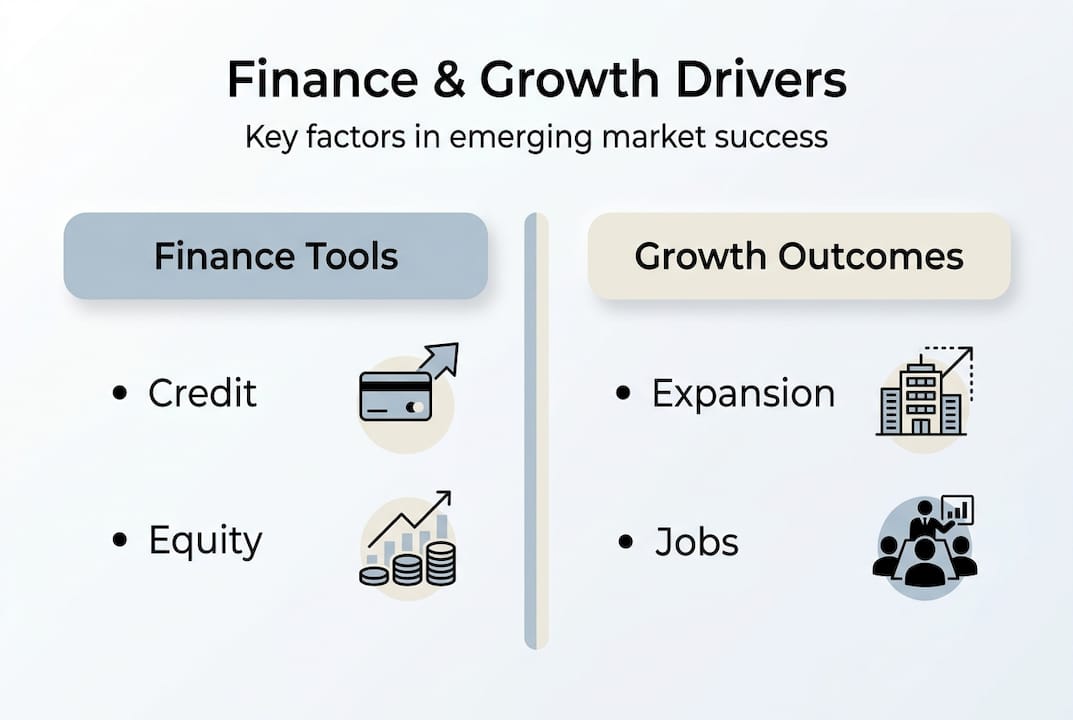
The asset side of the equation receives insufficient attention. Too many firms focus exclusively on securing financing without rigorous plans for deployment. Capital must flow into assets that generate returns above the cost of capital. This means investing in equipment that increases output, technology that improves efficiency, or market expansion that captures new revenue. Unproductive asset accumulation destroys value even when financing terms appear favorable.
Strategic financial practices for emerging market firms include several critical elements:
Lifecycle-matched financing: Align financing duration with asset useful life and payback periods to avoid maturity mismatches that create refinancing risk.
Hybrid instruments for flexibility: Use convertible notes, mezzanine debt, or revenue-based financing that adjusts to performance and provides multiple exit paths.
Long-term financial modeling: Build scenarios that stress-test capital structures against currency devaluation, interest rate spikes, and demand shocks common in emerging markets.
ESG profile development: Building strong ESG credentials increases eligibility for development finance and hybrid capital, opening access to concessional terms and impact investors.
Relationship banking: Cultivate deep relationships with multiple financial institutions to maintain access during market disruptions when transactional lenders withdraw.
These practices work together as a system. Lifecycle matching reduces risk, making hybrid structures more attractive to investors. Strong financial modeling demonstrates sophistication that builds lender confidence. ESG credentials differentiate you in competitive capital markets. Relationship banking provides stability when markets turn volatile.
Strategy | Implementation | Expected Outcome |
Debt/equity optimization | Maintain ratios under 1:1, focus on asset productivity | Reduced volatility risk, higher ROA |
Lifecycle matching | Align financing terms with asset payback periods | Lower refinancing risk, improved cash flow |
ESG development | Implement reporting, governance, and sustainability practices | Access to development finance, lower cost of capital |
Hybrid financing | Use convertible and performance-based instruments | Flexibility for growth stages, reduced dilution risk |
Pro Tip: Treat your capital structure as a strategic asset that requires active management, not a static decision made once during fundraising. Review and optimize quarterly as market conditions and business performance evolve.
Practical application requires understanding your specific context. A manufacturing firm expanding production capacity needs different financing than a service company entering new markets. Capital-intensive businesses benefit from longer-term debt matched to equipment depreciation. Asset-light businesses may prefer equity or revenue-based structures that scale with growth without fixed obligations.
Access professional guidance to navigate these choices effectively. Corporate finance solutions help structure optimal capital mixes for your industry and growth stage. Investment advisory services provide market intelligence and investor access that improves terms. Business planning and analysis builds the financial models and projections that demonstrate creditworthiness to lenders and appeal to equity investors.
The strategic imperative is clear. Finance is not merely a support function or a means to fund predetermined plans. In emerging markets, financial strategy directly determines competitive outcomes. Companies that master capital structure optimization, that build relationships across the financial ecosystem, and that deploy capital with discipline consistently outperform peers. The evidence from African debt benchmarks and strategic financial practices confirms this pattern across markets and sectors.
Partner with Maramoja Enterprises for expert financial guidance
Navigating the complexities of emerging market finance requires specialized expertise and deep market knowledge. Whether you are optimizing your capital structure, seeking development finance, or structuring a major transaction, professional guidance accelerates results and reduces costly mistakes.

Maramoja Enterprises delivers tailored investment advisory services that maximize growth potential in Africa and Dubai markets. Our corporate finance services support optimal capital structure decisions, from debt-equity balancing to hybrid instrument selection. When you need capital access, our loan procurement solutions leverage extensive lender networks and 20 years of market relationships to secure favorable terms. We translate the strategic principles outlined in this guide into actionable plans customized for your business context, industry dynamics, and growth objectives.
Frequently asked questions
How can small businesses in emerging markets use finance to grow?
Small businesses should focus on flexible, hybrid financing matched to their specific growth stage rather than pursuing traditional debt that may prove unsuitable. The finance-growth link is weaker or negative for small firms in emerging markets, making careful tailoring of finance instruments essential. Risk mitigation through diversified funding sources and building credit profiles through consistent reporting and relationship banking creates pathways to better capital access. Start with revenue-based financing or equity from impact investors before layering in debt as your track record strengthens.
What are the risks of relying on government debt for business financing?
Government debt can either facilitate or crowd out private business borrowing depending on type and source. External government debt can crowd in corporate borrowing by signaling creditworthiness to international lenders, while domestic debt crowds out private sector financing by absorbing local capital. Blended finance structures shift risk to governments, potentially limiting sustainable private sector growth by creating contingent liabilities that constrain future public borrowing capacity. Monitor both the level and composition of sovereign debt in your market to anticipate credit availability changes.
Why is ESG important for accessing development finance?
ESG compliance signals strong risk management and long-term sustainability to lenders and investors who increasingly screen for these factors. Building strong ESG credentials increases eligibility for development finance and hybrid capital in emerging markets by meeting criteria that multilateral institutions and impact investors require. It broadens access to concessional and blended finance instruments that offer below-market rates or flexible terms. Beyond capital access, ESG practices often improve operational efficiency and reduce regulatory risk, creating value independent of financing benefits.
How should emerging market firms balance debt and equity for growth?
Prioritize maintaining a debt-to-equity ratio below 1:1 in volatile emerging markets to manage currency and interest rate risk effectively. Focus equally on the asset side by deploying capital toward productive assets that generate returns exceeding your weighted average cost of capital. This dual focus on liability structure and asset productivity creates sustainable growth rather than fragile leverage. Adjust the specific ratio based on your industry capital intensity, revenue stability, and access to hedging instruments that can mitigate some emerging market risks.
What financing models best suit different stages of business growth?
Early-stage businesses benefit from equity and revenue-based financing that align investor returns with company performance without creating fixed obligations. Growth-stage companies can introduce hybrid instruments like convertible notes that provide debt-like returns with equity upside, matching the higher risk profile. Mature businesses with stable cash flows can utilize traditional debt structures, particularly in more developed emerging markets with deeper credit markets. Always match financing duration to the useful life of assets being funded and maintain flexibility to refinance or restructure as market conditions change, which they inevitably do in emerging economies.
Recommended
Comments